Why I Switched From Volta to Dyness — And What It Cost Me
Battery ecosystem compatibility is one of the least discussed risks in residential solar, and it cost me a full battery replacement when I expected a simple expansion. This article documents what happened, why it happened, what I chose instead, and what every prospective solar buyer should ask before committing to any battery brand.
The Original Setup
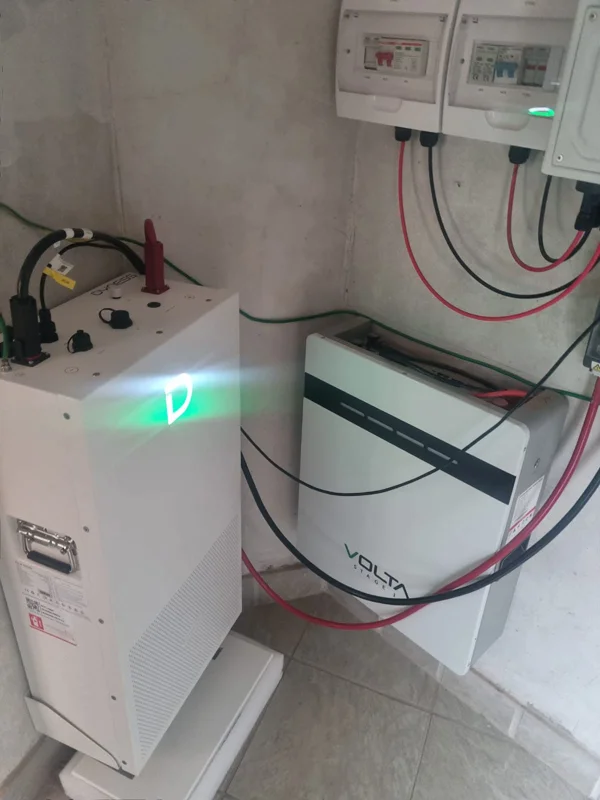
My original system included a Volta Stage 1 5kWh lithium battery installed alongside a Deye 5kW hybrid inverter. At the time of installation in 2023, the combination worked exactly as intended for load shedding backup and partial grid support. The Volta battery communicated correctly with the Deye inverter, charged and discharged on schedule, and provided enough overnight autonomy to cover most load shedding slots.
My expectation was straightforward: as my energy needs grew, I would add another Volta module, scale the storage incrementally, and eventually have enough capacity for longer overnight autonomy. That is how the product was presented, and it seemed like a reasonable plan.
The Expansion Problem
When I later investigated expanding the battery bank, I discovered that the BMS communication interface used in the newer Volta modules was not directly compatible with the version installed in my system. The manufacturer had updated the protocol between production runs. Adding another unit was not simply a matter of connecting a new module in parallel — the communication mismatch meant the batteries could not share state-of-charge information correctly with the inverter, which creates safety and charging management problems that cannot simply be worked around.
This left me with three options: find a second-hand module of exactly the same generation as my existing unit, pay a premium for a compatibility adapter solution if one existed, or replace the battery ecosystem entirely. None of these were the "buy another module" expansion I had anticipated.
Why BMS Compatibility Matters More Than Capacity
Modern lithium battery systems are not passive storage devices. They are active systems where the battery management system continuously communicates with the inverter about state of charge, temperature, cell voltage, charge rate limits, and discharge protection thresholds. When that communication works correctly, the inverter can optimise charging without overcharging, protect cells from deep discharge, and balance the system safely. When it breaks down — because the protocol has changed between generations, because the brands use different communication standards, or because firmware updates have shifted the interface — the integration becomes unreliable or non-functional.
This is a risk that almost no solar salesperson discusses at point of sale, because at the point of sale the system works perfectly. The problem only manifests when you try to grow it. And by the time you discover the constraint, you have already sunk the cost of the original battery into a system that cannot be expanded in the way you planned.
Choosing the Dyness PowerBrick Plus
After evaluating my options, I chose to migrate to the Dyness PowerBrick Plus. The decision rested on several factors: the 16kWh capacity represented a substantial jump from the 5kWh it replaced; the Dyness-to-Deye integration is well-documented and widely used in the South African market; the BMS communication protocol is established and stable; and the PowerBrick Plus has a modular expansion path that has remained consistent across product generations — something I researched carefully before committing.
| Comparison |
Volta Stage 1 |
Dyness PowerBrick Plus |
| Usable Capacity |
~4.5kWh |
~15.4kWh |
| Chemistry |
LiFePO4 |
LiFePO4 |
| Deye Compatibility |
Yes (original generation) |
Yes (well-documented) |
| Expansion Path |
Problematic (protocol change) |
Modular — consistent protocol |
| Cost at Purchase |
R23,000 |
R30,900 |
The cost of the migration — R30,900 for the Dyness unit plus R700 for transport and R1,025 for installation — is documented in full in the complete system cost breakdown. It is worth noting that this cost came on top of the R23,000 already spent on the Volta battery, which still had usable life remaining. The sunk cost of a battery that cannot be expanded the way you planned is real money.
The Difference the Upgrade Made
The operational change from 5kWh to 16kWh of storage is not linear — it is categorical. With 5kWh, the system required active load management during the evening to avoid draining the battery before morning solar production began. With 16kWh, the system can support normal household behaviour through the night and still have 30–50% SoC remaining at sunrise. The data from eight days of full off-grid winter operation proves this: the lowest overnight SoC reached in normal operation was 22%, on a night starting from only 49%, and the system recovered fully the following day on winter solar production alone.
The upgrade also changed the psychological experience of off-grid operation in a way that is difficult to quantify but entirely real. Managing a 5kWh battery through an evening requires constant awareness. A 16kWh battery provides enough headroom that you can behave like a normal household and monitor the numbers with interest rather than anxiety.
Questions to Ask Before Buying Any Battery
Based on what I learned from this experience, these are the questions I would ask every battery supplier before committing to a purchase — and I would want the answers in writing, not verbal assurances at point of sale.
First: can this battery be expanded later, and if so, with which specific models? Ask for the model numbers of compatible expansion units, not just a general "yes, it's expandable." Second: has the BMS communication protocol changed between product generations, and what happens to existing installations when it changes again? Third: what is the inverter compatibility list, and is my specific inverter model and firmware version on it? Fourth: if the manufacturer exits the South African market or discontinues this product line, what are the expansion options? Fifth: what is the warranty process in South Africa, and who handles it — the importer or the manufacturer directly?
These questions may feel excessive at the time of purchase. They will feel essential if you need to expand a system two years later and discover that the straightforward path no longer exists.
Final Thought
Solar systems evolve. Very few homeowners install their final system on day one. Energy needs change, technology changes, and what looks like adequate capacity in year one often looks like a constraint by year three. The battery decision is therefore not just about what you need today — it is about what your expansion path looks like when today's needs grow. Choose the battery brand that lets you expand predictably, not just the one that costs least at the point of initial purchase.
For a full review of the Dyness PowerBrick Plus, see the Dyness review page. For performance data from the upgraded system in real off-grid winter conditions, see My First Week Completely Off-Grid.