How I'm Turning a R23,000 Sunk Cost Into a Secondary Solar System
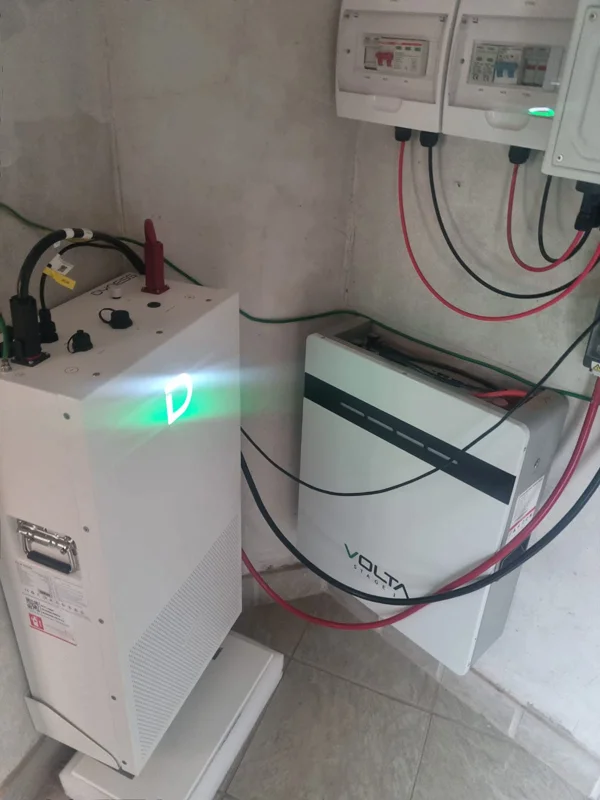
When I replaced my original Volta 5kWh battery with the Dyness PowerBrick Plus 16kWh, the Volta didn't die. It didn't fail. It simply couldn't be expanded — a BMS communication issue between first-generation and newer Volta modules meant scaling the battery bank was impossible without replacing the ecosystem entirely. The full story of that decision is in the Volta to Dyness article, but the short version is this: I had a perfectly functional 5kWh LiFePO4 battery sitting unused, representing R23,000 of investment that I had mentally written off.
The obvious move was to sell it. The realistic price for a first-generation Volta on the secondhand market is around R6,000 — a painful loss on a battery with years of usable life remaining. I was not comfortable with that outcome, so I started thinking about what else the Volta could do.
What I landed on is a secondary solar system — a separate Growatt inverter, a small panel array, and the Volta battery running as a standalone unit, with its AC output feeding directly into the Deye 5kW's generator input port instead of a conventional generator. The Volta gets a useful second life. The main system gets a backup energy source. And a R23,000 asset that was heading toward a R6,000 exit produces value for another seven or more years.
The Topology: How It Actually Works
The Deye 5kW hybrid inverter has a dedicated GEN input port — a terminal block physically labelled "GEN" on the unit — designed to accept AC input from a generator. What Deye's own documentation also confirms, and what a community of solar engineers has verified in practice, is that this port supports something more elegant: AC coupling from a secondary grid-tied or hybrid inverter.
In Deye's terminology this is called "Micro Inv Input" mode. The manual states explicitly that the GEN port can be used as a "micro-inverter or grid-tied inverter input (AC coupled)" and that "this feature will also work with Grid-Tied inverters." The practical effect is that whatever the secondary inverter produces — solar generation from its panels, or discharge from the Volta battery — arrives at the Deye's GEN port as clean 230V AC, and the Deye treats it as a supplementary power source exactly as it would treat a running generator.
The elegance of this topology is in how it handles a full battery. When the Dyness 16kWh on the main system reaches 100% SoC and cannot absorb any more charge, the Deye raises its output frequency — from the standard 50Hz toward 51 or 52Hz. The secondary inverter on the GEN port detects this frequency deviation, interprets it as a signal to curtail output, and ramps down accordingly. No communication cable between the two inverters. No complex configuration. The frequency shift is the language they speak, and the Deye is already designed to speak it.
When the main battery is low and needs supplementary input — a prolonged overcast period, a high-demand evening, the kind of situation where the 16kWh reserve is being drawn down faster than the main array can recover it — the Deye brings the GEN port back to 50Hz, the secondary inverter sees a normal frequency and resumes output, and the Volta's stored energy flows into the main system's load circuit.
The Components: What the Secondary System Needs
The secondary system is deliberately minimal. Its job is not to be a primary power source — the main Deye and Dyness system handles that. Its job is to extract remaining value from the Volta battery and provide a backup input to the main system during extended low-production periods.
| Component |
Purpose |
Estimated Cost |
| Growatt hybrid inverter (~3kW) |
Manages Volta battery and panel array, outputs AC to Deye GEN port |
R6,000–R8,000 |
| JA Solar panels (2–4 × 550–660W) |
Charges the Volta battery during daylight |
R3,000–R6,000 |
| Cabling, protection, installation |
AC run to Deye GEN port, DC wiring for panels |
R3,000–R4,000 |
| Volta 5kWh battery |
Already owned — R0 additional cost |
R0 |
| Estimated Total |
|
R12,000–R18,000 |
At the upper end of that estimate, the secondary system costs R18,000. Compare that to selling the Volta for R6,000 and spending nothing: the question is whether the secondary system's contribution to the main system over the Volta's remaining life — conservatively seven years at LiFePO4 cycle life rates — justifies the R12,000 net difference. Given that the system provides genuine backup depth during the worst production days, and given that the alternative to a generator on those days is drawing the Dyness bank lower than ideal, the answer is clearly yes.
The Panel Sizing Logic
The panel array on the secondary system does not need to be large. Its primary function is to keep the Volta battery charged so it is available when needed, not to provide significant surplus to the main system under normal conditions. A 2 × 660W array producing roughly 1.3kW peak will charge a 5kWh battery from 20% to 100% in approximately four winter hours — well within the available solar window even on moderate days.
The option to expand the panel array later is deliberately preserved. If the secondary system proves to provide more value than initially expected — particularly heading into summer when production from the main array will significantly exceed the current winter figures — additional panels can be added to the Growatt's MPPT input without any changes to the GEN port connection or the Deye configuration. The secondary system grows independently of the primary one.
The Volta Battery: Genuinely Fine for This Role
The Volta 5kWh battery's limitation is specific and well-defined: it cannot communicate with any Volta battery outside its own first-generation production run, which means the bank cannot be expanded. That limitation is completely irrelevant in this application. The secondary system is built around a single Volta unit running standalone on its own inverter. There is nothing to expand. The BMS functions correctly, the cells are in good condition, and at LiFePO4 cycle life rates the battery has a minimum of seven years of useful life remaining under normal depth-of-discharge operation.
When the Volta does eventually reach end of life, replacement is uncomplicated. The Growatt inverter will accept any LiFePO4 battery that communicates via standard protocols — Pylontech, Dyness, BYD, or a number of others — giving complete flexibility at that point without any changes to the rest of the system architecture.
What Still Needs to Be Confirmed
The concept is technically validated by Deye's own documentation and confirmed in practice by other installers. What remains to be finalised before purchase is the specific Growatt model selection. This matters because the secondary inverter needs to respond correctly to the Deye's frequency-shift curtailment signal. A conventional grid-tied inverter is frequency-responsive by design — it will ramp down when the Deye raises frequency to signal a full battery. A hybrid inverter used as the secondary unit requires more careful selection, because hybrid inverters are designed to be the master of their AC output, not a frequency-following slave.
The Growatt model needs to satisfy two conditions: it must accept the Volta battery's BMS communication or operate correctly without it in a standalone configuration, and its AC output must respond to frequency deviation from the Deye in the curtailment direction. A Growatt SPF series unit running in the appropriate mode, or a small Growatt grid-tied unit with the Volta managed separately, are both viable paths. The specific model will be confirmed with a Growatt-authorised supplier before purchase, and this article will be updated with the exact specification once that decision is made.
The Bigger Picture: What This System Will Look Like
Once complete, the full energy architecture of the property will look like this: the main Deye 5kW inverter manages the primary load circuit, powered by approximately 5.7kW of JA Solar panels and the Dyness 16kWh battery. The secondary Growatt inverter manages its own smaller panel array and the Volta 5kWh battery, outputting AC to the Deye's GEN port. The Deye draws on that GEN port input when the main battery needs supplementary support — extended overcast conditions, high evening loads, or any scenario where the 16kWh reserve drops below a configured threshold.
The result is a total of 21kWh of battery storage across two systems, two independent panel arrays generating from different mounting positions on the property, and a backup energy path that costs a fraction of what a conventional generator would cost to purchase, fuel, maintain, and store. No fuel. No noise. No weekly test runs to keep the engine alive. The backup system is solar, silent, and runs on the same energy that powers everything else.
It is also, in a straightforward sense, the correct outcome for a battery that was purchased for R23,000, has years of functional life remaining, and was heading toward a R6,000 exit. The secondary system converts a sunk cost into ongoing infrastructure. That is engineering that makes financial sense as well as technical sense.
What Comes Next
The Growatt inverter model will be confirmed and purchased once the supplier consultation is complete. Panel count will be finalised at that point — starting conservatively with two or three 660W units and expanding later if the system proves to warrant it. Installation will be documented in full, including the Deye GEN port configuration settings, the Growatt setup, and the first performance readings from the combined system.
The follow-up article — covering the actual installation, the configuration, and the first real-world data from the secondary system operating alongside the primary — will be published once the upgrade is complete. If you are considering a similar approach for a battery that can no longer be expanded within its original ecosystem, the system design documented here gives you the conceptual framework. The specific component decisions will follow.
The Deye "Micro Inv Input" feature referenced in this article is documented in Deye's official inverter manuals for the SUN-5K-SG03LP1 and related models. Availability of this feature depends on installed firmware version — confirm with your installer before purchase. All electrical work must comply with SANS 10142 and be carried out by a registered electrician. For product reviews of the inverters and batteries referenced in this article, see the Deye inverter review and Dyness battery review.