Can a 5kW Hybrid Inverter Really Run a Home Off-Grid?
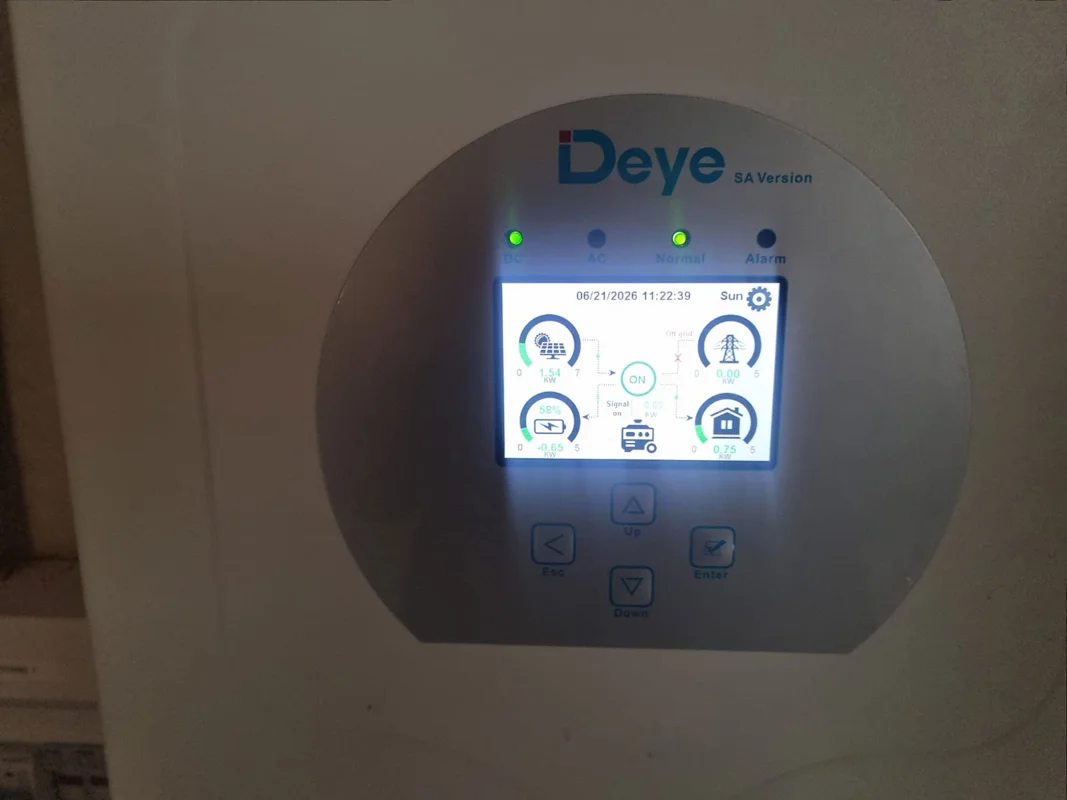
This is one of the most common questions in South African solar forums, and the answer most people want — a simple yes or no — is not the useful one. The real answer is: yes, under specific conditions, and those conditions have much more to do with your battery and your behaviour than with the inverter itself. I have been running my home completely off-grid on a Deye 5kW hybrid inverter since 13 June 2026, and I have eight days of continuous SolarmanPV telemetry data to show what that actually looks like in South African winter conditions, on a shaded forested property in KZN.
The Short Answer, With Evidence
Yes, a 5kW hybrid inverter can run a home off-grid. Across eight consecutive days — including nights with household loads averaging 150–500 watts and occasional spikes to 2,300–2,400 watts for larger appliances — the system has drawn exactly 0.00 watts from the grid in every single 5-minute telemetry reading. The battery's lowest SoC in normal operation was 22%, reached on the morning of 15 June after starting the night at 49%, and it recovered to 66% by that afternoon on winter solar alone. Peak daily production has ranged from 1,158W on a heavily overcast day to 3,794W on a clear winter day.
Those numbers are from a real system, in real winter conditions, with real shading constraints. The 5kW inverter has handled all of it without complaint.
The longer, more useful answer requires understanding what "running a home off-grid" actually depends on — because the inverter's 5kW rating is almost the least important variable in the equation.
What Actually Determines Off-Grid Success
The inverter's job in a hybrid system is to manage the conversion between DC solar production, AC household consumption, and battery charging and discharging. A 5kW inverter can deliver up to 5,000 watts to the house at any given moment, which covers the simultaneous operation of most household appliances with the exception of very large heating elements, high-draw pool pumps, or three-phase industrial equipment. For a typical South African home, 5kW of instantaneous capacity is sufficient for normal operation with reasonable appliance discipline. You cannot run the stove, the kettle, the geyser, and the dishwasher simultaneously — but most grid-connected households do not do that either, because it trips the mains breaker.
What determines whether off-grid operation is sustainable over days and weeks is not the inverter's peak output but the relationship between three other variables: how much the battery can store, how much the panels can generate each day, and how much the household actually consumes. The inverter is the pipe. The battery and the panels determine whether there is enough water in the system to flow through it.
Battery Capacity Is the Critical Variable
The single most important upgrade in my system was not to the inverter. It was replacing the original 5kWh Volta battery with a Dyness PowerBrick Plus 16kWh. The difference between those two batteries in an off-grid context is categorical rather than incremental. With 5kWh of storage, a household running 300 watts overnight will exhaust the battery in roughly 15–16 hours, which means even a medium-length KZN winter night tests the limits of the system. With 16kWh of storage, the same overnight draw represents less than 20% of capacity — giving the following day's solar production an enormous margin with which to recover.
The telemetry data illustrates this precisely. Overnight the system draws 130–200 watts from the battery during quiet hours, and 150–500 watts during active evening use. Across a full overnight cycle from sunset to sunrise, the battery typically gives up 2.4–3.4 kWh. On a 16kWh battery that is manageable. On a 5kWh battery it would require the system to start the night fully charged every single day, and any cloudy afternoon that prevented full recharging would create a shortfall the following morning.
Load Management Matters — But Not the Way People Assume
Off-grid living requires more electrical awareness than grid-connected living, but it does not require the austere rationing that many people associate with the term. What changes is timing and simultaneity, not total consumption. Running the kettle and the microwave at the same moment draws more than 2,000 watts from the inverter — which it handles fine — but does it while the battery is already discharging on an overcast afternoon draws on reserves faster than necessary. Running the geyser during peak solar production hours in the morning, rather than on an overnight timer, means the panels pay for it directly rather than the battery. These are not hardships. They are habits that any household can develop within a week of monitoring the system.
What the 5kW inverter cannot do easily is run a large conventional electric geyser, a pool pump, and a stove simultaneously — but that combination would also trip the circuit breaker in most grid-connected homes. The practical constraint of off-grid operation on a 5kW system is similar to the practical constraint of a 60A mains supply: most of the time it is invisible, and it only becomes relevant when you try to run everything at once.
Winter Is the Real Proof
The common failure mode in off-grid planning is using summer production figures to justify the system design and then discovering in June that the reality is considerably different. In South African winter, solar production windows shorten, sun angles drop, and shading that was marginal in December becomes significant in July. Any system that works in winter will work year-round. A system that works in summer may not survive its first July intact.
My system has been operating off-grid exclusively during winter, on a shaded forested property, with production peaks ranging from the low thousands to nearly 3,800 watts depending on cloud cover. The worst day — 16 June, heavy overcast — peaked at 1,158 watts and left the battery at 40% SoC going into the night. The system handled it. The 5kW inverter was not the constraint on that day. The weather was, and the 16kWh battery provided enough cushion that the shortfall was absorbed without incident.
The Conditions Under Which a 5kW System Works Off-Grid
To make this concrete: a 5kW hybrid inverter can sustain a typical South African home off-grid if the battery storage is at least 10–16kWh of usable capacity, the panel array is sized to produce at least 6–8 kWh per day in winter conditions at your specific location, the household avoids large simultaneous high-draw loads during low-production periods, and the system has been given time to evolve — because first installations are almost never final installations, and the iterative improvements to panel placement, mounting height, battery capacity, and load behaviour are what turn a hybrid system into a genuinely reliable off-grid one.
What will not work reliably off-grid is a 5kW inverter paired with 5kWh of battery storage, regardless of panel size, because the storage buffer is insufficient for the overnight periods that define off-grid viability. The inverter is fine. The battery is the constraint, and it is a constraint that is easily underestimated when the primary design driver is surviving load shedding slots rather than sustaining indefinite grid independence.
Final Answer
A 5kW hybrid inverter can absolutely run a home off-grid. What it cannot do is run a home off-grid alone. The inverter needs adequate battery backing, a panel array matched to real winter production at your location, and a household that understands the difference between what the system can deliver and what the grid used to deliver on demand. Get those three things right, and the inverter size becomes almost incidental. Get them wrong, and even a 10kW inverter will eventually run short.
All performance figures cited in this article are drawn from SolarmanPV telemetry data from 13–20 June 2026. For the full dataset and analysis, see My First Week Completely Off-Grid. For product reviews of the inverter and battery used in this system, see the Deye inverter review and Dyness PowerBrick Plus review. All solar electrical work must comply with SANS 10142 and be carried out by a registered electrician.