How an Eskom Billing Dispute Forced Me Completely Off-Grid
On 29 May 2026, Eskom disconnected my electricity supply while an active billing dispute remained unresolved. I had spent months trying to reconcile conflicting meter readings, estimated invoices, historical billing inconsistencies, and complications arising from my existing solar installation. What began as a billing dispute ultimately forced a decision I had only partially planned: removing my dependence on the grid entirely. This article documents that transition — from disputed invoices and disconnection notices to a fully independent residential solar system operating completely off-grid under real South African winter conditions.
This is not a theoretical "dream solar setup." It is a practical, incremental system built over several years on a heavily forested, shaded property with real engineering constraints, real financial limitations, and real operational lessons learned the hard way.
How the Dispute Started
The dispute began when I noticed that the meter readings reflected on my account did not match the physical readings on the meter installed at my property. Initially I assumed it was an isolated administrative error that could be resolved through normal channels. It was not. Over several months I submitted photographs of the physical meter, account queries, reconciliation requests, historical billing comparisons, and multiple written communications requesting clarification.
One significant complicating factor was that my property already had a solar installation connected to a legacy meter configuration. Like many South Africans who installed solar before bidirectional metering became common, my system could under certain conditions export excess power back toward the grid. This created additional uncertainty around historical consumption calculations and meter interpretation — a situation Eskom's billing systems were not well equipped to handle cleanly.
Throughout this process I made clear that I was willing to pay for legitimate electricity usage once the account had been properly reconciled. The core issue was never avoiding payment. It was accuracy. Despite that, and despite ongoing formal escalation, disconnection proceeded while substantive issues remained unresolved. That moment changed how I viewed energy security. As long as another institution controlled my access to electricity, my household remained vulnerable — regardless of how valid my dispute might ultimately prove to be.
My Solar System: Built Incrementally Over Three Years
My system was never built in a single purchase. Like most South African homeowners who installed solar during the load shedding crisis, I expanded it in stages as budgets allowed and needs evolved. The original 2023 setup was designed for backup resilience, not permanent off-grid operation.
| Component |
Cost |
| Deye 5kW Hybrid Inverter |
R23,000 |
| Volta Stage 1 5kWh Battery |
R23,000 |
| 6× JA Solar 550W Panels |
R12,000 |
| Wiring & Installation |
R6,500 |
| Original System Total |
R64,500 |
The Deye inverter performed reliably as a hybrid unit during the load shedding years, handling the grid-tied and battery functions without issues. The JA Solar panels also proved solid performers despite the shading challenges described below.
The Reality of Solar on a Forested Property
Almost every solar article you read assumes an open, unshaded rooftop with ideal panel orientation. My property is a heavily forested site in KZN, which creates serious shading problems — particularly in winter when the sun angle drops. To make the system viable, I had to invest in infrastructure that most solar ROI calculators completely ignore.
| Additional Infrastructure |
Cost |
| Pergola Construction |
R7,500 |
| Pergola Extension + Roof Structure |
R25,000 |
| Arborist Tree Trimming |
R3,000 |
| Infrastructure Total |
R35,500 |
Raising the panels higher on an extended mounting structure reduced shading losses significantly. The arborist work had to be repeated seasonally as trees continued to grow back. These are recurring, ongoing costs that affect the real-world ROI of any system in a similar environment.
Expanding the Array
As my dependence on solar increased, I added a second string of panels to improve generation during limited winter sunlight windows. The additional panels were mounted at a higher elevation than the originals to further reduce morning shade losses.
| Component |
Cost |
| 4× JA Solar 600W Panels |
R5,000 |
| Additional Cabling, Combiner Boxes & Protection |
R2,600 |
| Labour |
R1,025 |
| Expansion Total |
R8,625 |
The Battery Problem Nobody Talks About
One of the most frustrating — and expensive — lessons from this build involved battery ecosystem compatibility. My original Volta 5kWh battery could not be easily expanded because the manufacturer had changed the BMS communication interface between production runs. Adding another unit was not a simple plug-and-play exercise; it required a full ecosystem change.
This is a critical issue that first-time solar buyers routinely underestimate. Choosing a battery brand based on initial price without researching the BMS expansion protocol and future product compatibility can lock you into a dead-end system within two or three years. I had to replace the entire battery setup rather than simply adding capacity.
I replaced it with a Dyness PowerBrick Plus 16kWh unit — a significant jump in usable storage that fundamentally changed what the system was capable of.
| Component |
Cost |
| Dyness PowerBrick Plus 16kWh |
R30,900 |
| Collection & Transport |
R700 |
| Installation Labour |
R1,025 |
| Trunking & Materials |
R70 |
| Battery Upgrade Total |
R32,695 |
Total Investment to Date
When you add up every component, every piece of infrastructure, and every labour cost, the real picture looks like this:
| Phase |
Cost |
| Original System (2023) |
R64,500 |
| Shading & Infrastructure |
R35,500 |
| Array Expansion |
R8,625 |
| Battery Upgrade (Dyness 16kWh) |
R32,695 |
| Total Invested |
~R141,320 |
That figure does not include the ongoing arborist costs, any future panel additions, the planned generator integration, or improved solar rail work still on the upgrade list. Off-grid independence has a real price — and it is considerably more than the inverter + panels + battery equation that most online calculators present.
Real-World Off-Grid Performance: Eight Days of Data
Since going fully off-grid on 13 June 2026 — the day of disconnection — I have been monitoring the system continuously via SolarmanPV telemetry. The data below is drawn directly from 5-minute interval readings across eight consecutive days of South African winter operation. No estimates. No theoretical projections. This is what the system actually did.
Daily Performance Summary
| Date |
Start SoC |
Lowest SoC |
Peak Production |
End SoC |
Conditions |
| 13 June |
56% |
35% |
3,794W |
78% |
Good — reached 100% by 13:45 |
| 14 June |
78% |
8%* |
3,105W |
52% |
BMS anomaly — see note |
| 15 June |
49% |
22% |
3,152W |
66% |
Good recovery from low SoC |
| 16 June |
49% |
39% |
1,158W |
40% |
Heavy cloud — lowest output day |
| 17 June |
40% |
31% |
2,645W |
54% |
Good — battery 31% → 72% daytime |
| 18 June |
53% |
40% |
2,542W |
66% |
Very good — reached 85% by 14:20 |
| 19 June |
66% |
52% |
2,724W |
62% |
Good — system gaining reserves |
| 20 June |
62% |
49% |
2,985W (by 11:10) |
86% (13:30) |
Good — still charging at time of writing |
* The 8% SoC reading on 14 June is almost certainly a BMS calibration event rather than a genuine depletion. The SoC reading collapsed from 100% to 8% in a very short window with no corresponding consumption spike that would explain such a rapid drain. The system continued operating normally throughout. This kind of BMS recalibration is documented behaviour in LiFePO4 systems after initial cycling — worth knowing about, but not a cause for alarm.
What the Data Actually Shows
Several things stand out when you look at eight continuous days of real winter operation on a shaded, forested property.
First, the battery never came close to exhaustion in normal operation. Outside of the Day 2 BMS event, the lowest overnight SoC reached was 22% on the morning of 15 June — and the system recovered to 66% by that afternoon using winter solar production alone. On most nights the battery maintained 35–52% SoC through to sunrise, when charging began between 06:15 and 07:30 depending on cloud cover.
Second, the range in daily peak production tells the real shading story. On 13 June, a relatively clear day, the system peaked at 3,794W — close to its theoretical maximum given the array size and shading losses. On 16 June, heavy cloud cover brought that peak down to just 1,158W. That single cloudy day was enough to leave the battery ending the night at only 40% SoC — a meaningful reminder that the system is weather-dependent and not yet engineered for worst-case resilience without a generator backup.
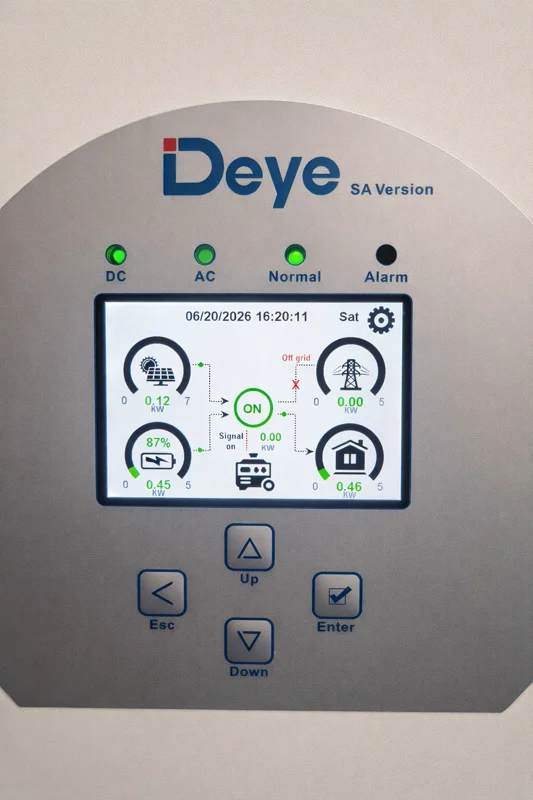
Third — and the figure I find most striking — grid power purchased across all eight days sits at exactly 0.00 watts in every single reading. Not once. In the middle of a South African winter, on a shaded forested property, a properly sized solar and battery system has kept a household running completely independently. The psychological shift that comes from watching that number sit permanently at zero is difficult to explain until you have experienced it.
Overnight Battery Behaviour
The overnight discharge data is particularly useful for anyone sizing a similar system. Between midnight and approximately 06:15, when the first trace of solar appears, overnight base load consumption averaged 70–80 watts — primarily standby loads, the inverter's own draw, and always-on devices. From 17:00 through to midnight, when the household was actively being used, average consumption ranged from 150 to 500 watts depending on activity, with periodic spikes to around 1,700–2,400 watts when high-draw appliances ran.
The 16kWh Dyness battery handled all of this without complaint. The gap between where the battery ended a day and where it started the next morning — accounting for overnight draw — typically represented 15–21% of capacity, equivalent to roughly 2.4–3.4 kWh overnight. For anyone considering a similar transition, this is a realistic benchmark for a modest KZN household in winter.
What I Learned
1. Documentation is Everything in a Dispute
Every meter reading, every invoice, every photograph, and every piece of written communication should be stored systematically from day one. Without a clear paper trail, billing disputes are extremely difficult to challenge and nearly impossible to escalate effectively. If you have a solar system connected to a legacy meter, document your meter readings monthly, in writing, with dated photographs.
2. Hidden Costs Are Where Solar Projects Go Wrong
The inverter, panels, and battery are just the starting point. Structural modifications, shading mitigation, tree management, combiner boxes, upgraded cabling, transport, and labour can add 30–50% to the component cost of a system built on a real property rather than a theoretical suburban rooftop. Plan for it from the beginning.
3. Battery Ecosystem Compatibility Must Be Researched Before Purchase
Ask the hard question before buying any battery: what happens when I want to add more capacity in two years? If the answer involves a different BMS communication protocol or a discontinued product line, that initial saving will cost you considerably more at upgrade time. The battery ecosystem decision is longer-term than the inverter or panel decision.
4. Shading Changes Everything
The difference between 3,794W peak output on a clear day and 1,158W on a cloudy winter day — on the same system, with the same panels — illustrates how much production variance a shaded property faces. Any system sizing calculation that uses ideal peak-hour figures without accounting for your specific shading profile will leave you short when you need the capacity most.
5. Energy Independence Changes the Power Dynamic
Once your household can function independently of the grid, utility disputes become administrative matters rather than existential ones. The coercive power that disconnection holds over a grid-dependent household disappears. Whether or not the original dispute is ever resolved in my favour, the system has already delivered something that no account reconciliation can take away.
Final Thoughts
I did not set out to go fully off-grid. Like many South Africans, I installed solar to survive load shedding and improve reliability. The Eskom billing dispute and subsequent disconnection accelerated a transition that I believe many more South African households will face or choose in the coming years — not necessarily because of billing disputes, but because the combination of rising tariffs, improving battery economics, and the lived experience of energy insecurity is pushing the calculus firmly toward independence.
Eight days of uninterrupted, grid-free operation in winter, on a forested property, with a system that was never designed to be fully off-grid — the data speaks for itself.
This article is a documented account of personal experience and is not legal or electrical engineering advice. All solar electrical work must comply with SANS 10142 and be carried out by a registered electrician. If you are considering a similar transition, consult a qualified solar installer in your area — visit our installer directory to find verified professionals near you.