Building Solar on a Forested Property: What Shading Really Costs You
Most solar content on the internet assumes one thing above all others: that you have a large, unobstructed, north-facing roof with clear sky exposure from morning to afternoon. The guides, the calculators, the YouTube walkthroughs — virtually all of them begin from that premise. If your property looks anything like mine, that premise fails from the first sentence.
I live on a heavily forested property in KwaZulu-Natal. Mature trees surround the house on multiple sides. In summer, when the sun is high and the solar window is long, the system performs reasonably well despite the vegetation. In winter — when the sun angle drops significantly, shadows lengthen, and the productive daylight window shortens — shading becomes the dominant engineering constraint on the entire installation. This article documents what I learned trying to solve that problem, what it actually cost, and what the real-world winter production numbers look like after three years of incremental improvement.
Why Shading Is a More Serious Problem Than Most People Think
The common mental model of solar panel shading is intuitive but wrong. People tend to assume that a panel in partial shade produces proportionally less power — shade 20% of the panel, lose 20% of the output. Solar string wiring does not work that way. In a series-wired string, the output of the entire string is constrained by the lowest-performing panel in that string. One partially shaded panel can drag down the output of every other panel connected to it, producing losses far disproportionate to the shaded area.
Modern optimiser and microinverter configurations mitigate this to varying degrees, but in a standard string configuration — which most hybrid inverter installations use — shading one section of one panel during a critical morning or afternoon production window can eliminate a substantial fraction of the day's total generation. In winter, when you have perhaps five or six hours of meaningful production rather than eight or nine, losing the first hour of morning output to shade that didn't exist in summer can meaningfully affect whether the battery fully recovers before the next overnight cycle.
My Property: The Constraints I Had to Work Around
The trees on my property are mature, established, and largely non-negotiable. Removing them entirely was never realistic or desirable — both for environmental reasons and because they provide meaningful protection from wind and summer heat. The engineering challenge was therefore to maximise solar production not by eliminating the obstruction, but by positioning the panels to capture as much unobstructed sky as possible within the constraints of the site.
This immediately disqualified the obvious solution of roof mounting. The existing roof structure sat too low relative to the surrounding canopy to provide the winter production needed. A dedicated mounting structure was the only viable path, which meant building before I could generate — an upfront infrastructure cost that conventional solar ROI calculations never account for.
The Pergola Solution: What It Cost and What It Achieved
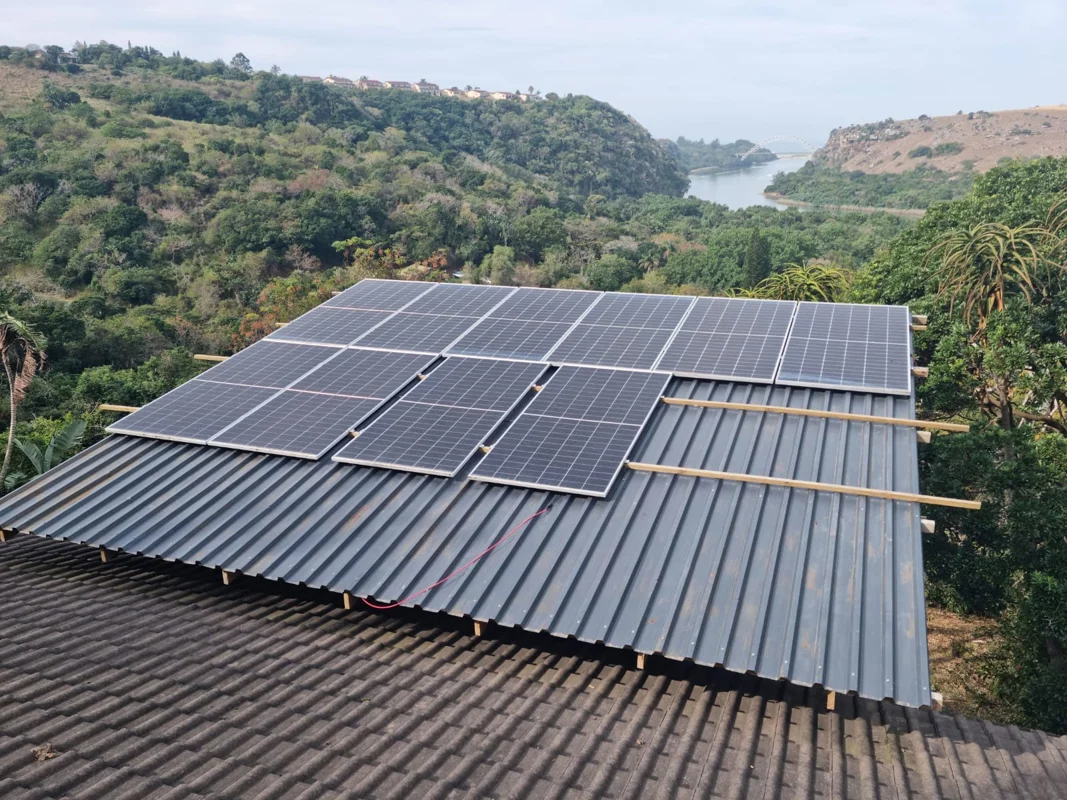
I constructed a dedicated pergola structure to mount the panels at a height where they could access a meaningful solar window even with the surrounding vegetation. The initial structure cost R7,500 and provided a workable but imperfect solution. As the system's role evolved and the need for winter production became more acute, I extended the structure significantly — widening the pergola, adding roof trusses, and installing an IBR roof section to create an elevated second mounting level. That extension cost R25,000, bringing the total structural investment to R32,500 before a single additional panel was purchased.
On top of that, I hired an arborist at R3,000 to trim the trees most directly affecting the winter production window. This is not a permanent fix — trees continue to grow, and this is now an ongoing seasonal expense rather than a one-time cost. Including it in the annual solar budget is essential for any forested property owner.
| Shading Mitigation Cost |
Amount |
| Initial Pergola Construction |
R7,500 |
| Pergola Extension & Elevated IBR Roof Structure |
R25,000 |
| Arborist Tree Trimming (initial) |
R3,000 |
| Total Shading Mitigation Investment |
R35,500 |
These costs represent roughly 25% of the total system investment documented in the complete off-grid cost breakdown. They appear in almost no online solar cost estimate, yet on this property they are as fundamental to the system's viability as the inverter itself.
Did It Work? What the Production Data Actually Shows
Since going fully off-grid in June 2026, I have eight days of continuous SolarmanPV telemetry that shows exactly what the improved system produces in South African winter conditions, on this forested property, after the structural improvements.
On clear winter days, the system peaks between 2,500W and 3,800W. The best single reading in the dataset was 3,794W at 11:15 on 13 June — approaching the theoretical maximum for the installed array given the shading constraints that remain. Solar production begins appearing in the telemetry at around 06:15 and reaches meaningful charging levels by 07:30. On good days the battery, which started the first week at 56% SoC, was back to 100% by 13:45.
On overcast days the picture is very different. 16 June produced a peak of only 1,158W — less than a third of the clear-day peak — and the battery ended that night at only 40% SoC. That variance is the honest picture of what winter solar looks like on a shaded forested property, even after significant investment in structural optimisation. The structural work reduced shading losses materially. It did not eliminate weather dependency.
What I Would Do Differently
The single most valuable thing I could have done earlier was a proper seasonal sun angle analysis before finalising panel placement. There are free online tools that will model sun path, shadow throw, and available solar hours for any location at any time of year. Using them seriously before construction would have allowed me to design the pergola height and orientation more precisely rather than iterating through an extension that added R25,000 to the project.
I would also have budgeted for shading mitigation from the very beginning rather than treating it as an afterthought when production fell short. If you are planning a solar installation on any property with significant vegetation, trees within 15–20 metres of your panel location, or neighbouring structures that cast shadows during your production window — model the shading before specifying the system. A system that produces well in December will often disappoint badly in June, and June is when you most need it to perform.
Finally, I would have specified the second string of panels at a greater height from the outset rather than adding it later. The higher-mounted second string noticeably outperforms the lower-mounted original array on winter mornings, and the incremental cost of getting the height right during initial construction is far less than retrofitting it afterward.
The Broader Lesson
Shaded properties are not disqualified from meaningful solar production. They do require more engineering thought, more structural investment, and more realistic expectation-setting than standard installations. The marketing images of solar systems — clean panels on clear suburban rooftops under blue skies — represent an ideal that most real South African properties only partially approximate.
If you are dealing with trees, neighbouring buildings, awkward roof angles, or winter shading constraints, the answer is not to give up on solar. It is to plan around the constraints honestly, budget for the structural solutions they require, and size your battery to cover the days when production falls short of consumption. The system works. The data proves it. But it works because of engineering decisions made above and around the panels, not despite the shadows.
For more on the full cost of building this system, see What It Really Cost Me to Go Off-Grid. For product reviews of the panels used in this installation, see the JA Solar panel review. All solar electrical work must be carried out by a registered electrician and comply with SANS 10142.