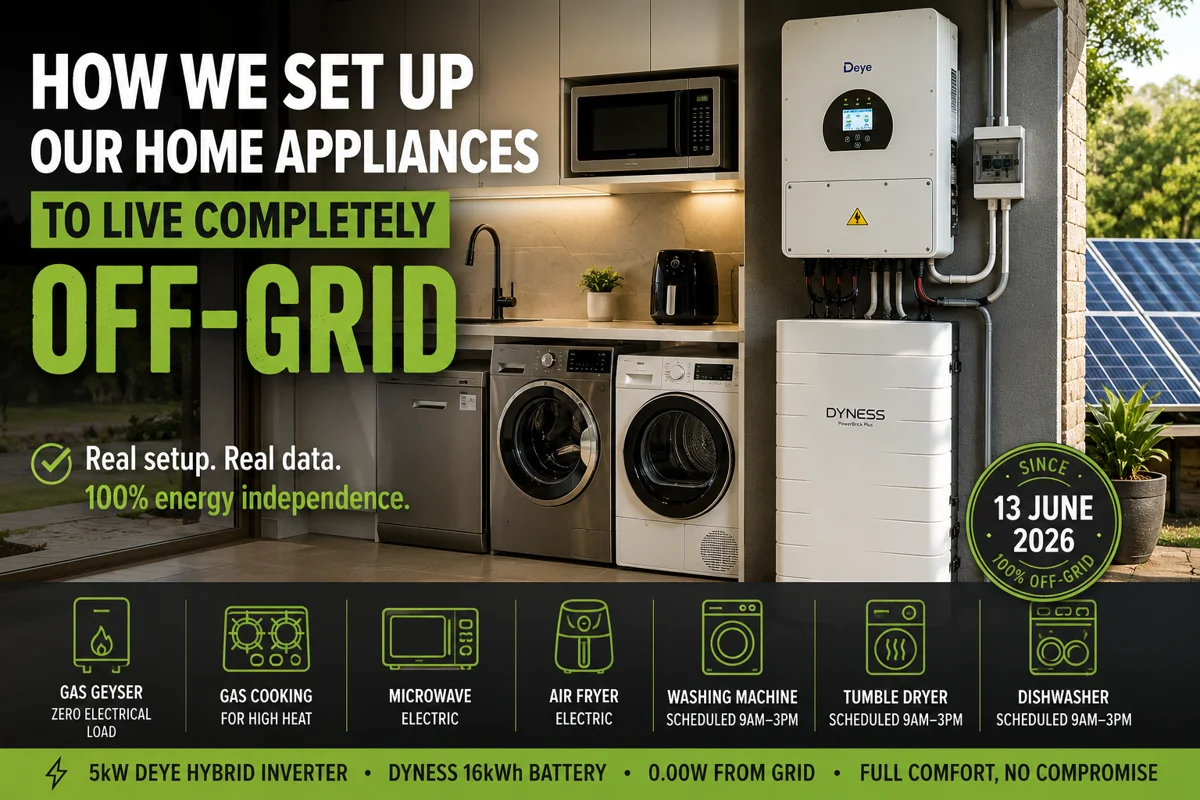
How We Set Up Our Home Appliances to Live Completely Off-Grid
Going off-grid is not primarily a solar question. The panels, inverter, and battery are the infrastructure - but what actually determines whether a household can sustain genuine off-grid independence is how that household uses energy. The appliance decisions, the scheduling habits, and the one or two strategic substitutions that remove the biggest electrical loads from the system entirely are what make the difference between a system that works in theory and one that works daily in practice.
This article documents the exact appliance setup in our home that has allowed us to operate completely off-grid since 13 June 2026 - running a full household, including a washing machine, tumble dryer, dishwasher, pool pump, borehole pressure pump, and microwave, on a Deye 5kW hybrid inverter and a Dyness PowerBrick Plus 16kWh battery, through a South African winter, on a shaded forested property. No generator. No grid fallback. No deprivation.
The telemetry data from SolarmanPV confirms what eight days of off-grid living feels like in numbers: evening household consumption consistently stays below 600 watts, large appliances run almost exclusively between 09:00 and 15:00 when solar is producing, and the inverter's highest recorded load across the entire period was 2,631 watts - just over half its 5kW capacity. The system has headroom. The household has comfort. What follows is exactly how that was achieved.
The Single Most Important Decision: Removing the Electric Geyser
If there is one appliance decision that makes off-grid living viable for a South African household, it is this one. The electric geyser is typically the largest single electrical load in a South African home - a 3kW or 4kW element heating 150–200 litres of water that then sits in an insulated tank losing heat until it is needed. In a grid-connected home it is almost invisible because it runs in the background on a municipal supply. In an off-grid home it is a system-defining problem: a 3kW load running for two hours consumes 6kWh, which is a significant fraction of the daily production budget and a large overnight battery draw if the geyser cycles on in the early morning hours.
We replaced the electric geyser completely with an instant gas geyser. The electrical draw of an instant gas geyser is effectively zero. Hot water on demand, no standing heat loss, no tank to maintain temperature, and no impact whatsoever on the solar system's energy budget. The gas cost is real and ongoing, but it is predictable, it is independent of electricity tariffs, and it removes what would otherwise be the most problematic load in the system from the inverter's responsibility entirely.
This was not a compromise. Hot water quality and availability are unchanged. The practical difference is that the system that was previously spending a meaningful fraction of its daily energy budget keeping a tank of water warm is now entirely free of that obligation.
Cooking: A Practical Hybrid of Gas and Electric
We use gas for the primary cooking functions - the hob and anything that requires sustained high heat - and electric for everything else. The kettle sits on the gas hob rather than being a plug-in appliance. A plug-in kettle drawing 2,000–3,000 watts for two to three minutes is a manageable load on the system, but doing it on gas costs essentially nothing in energy terms and removes another spike from the solar budget. When the gas is already on for cooking, boiling water on it is simply the sensible option.
The microwave and air fryer remain electric and we use them regularly. A microwave running at 1,000–1,200 watts for three minutes draws about 0.06 kWh - genuinely negligible in the context of a 16kWh battery. The air fryer is heavier at 1,200–1,800 watts but runs for short periods and produces no significant impact on the daily energy balance. These are not appliances that require scheduling management. They run when needed.
The stove and oven, by contrast, would be significant loads if they were electric. A conventional electric oven running at 2,000–2,500 watts for an hour consumes 2–2.5 kWh - enough to meaningfully affect the afternoon SoC on a marginal production day. Keeping the high-heat cooking on gas removes that variable from the system entirely and is the second most impactful appliance decision after the geyser replacement.
The High-Draw Appliances: Scheduling Is Everything
The washing machine, tumble dryer, and dishwasher are all running off the solar system. This surprises people, because these are exactly the appliances most often cited as incompatible with smaller off-grid systems. The key is not whether you run them - it is when.
The SolarmanPV telemetry makes the scheduling pattern visible in the data. Consumption spikes above 1,500 watts appear almost exclusively between 09:00 and 15:00 in the dataset. Readings of 1,600–1,880 watts correspond to the washing machine running alone. Readings of 2,270–2,631 watts correspond to the washing machine and tumble dryer running simultaneously, or the tumble dryer running with another appliance. Every single one of those high-draw events happens during the solar production window - which means the panels are paying for them directly rather than drawing the battery down.
The practical rule is simple: washing machine and tumble dryer run during peak production hours, which in winter means broadly 09:00 to 14:00. The dishwasher runs in the same window. These are not rigid scheduling constraints - they are habits that took about a week to establish and now feel entirely natural. What we do not do is run these appliances in the evening or overnight, which would draw the battery down unnecessarily when the same load could be deferred until the sun is covering it.
| Appliance |
Approximate Draw |
When We Run It |
Battery Impact |
| Washing machine |
500–1,800W |
09:00–14:00 only |
Minimal - solar covers it |
| Tumble dryer |
2,000–3,000W |
09:00–14:00 only |
Minimal - solar covers it |
| Dishwasher |
1,200–1,800W |
09:00–14:00 preferred |
Minimal when scheduled correctly |
| Microwave / air fryer |
800–1,800W |
Any time - short bursts |
Negligible |
| Pool pump |
~750W |
Solar hours only |
None - never runs overnight |
| Pressure pump (borehole) |
370–628W |
On demand - any hour |
Seconds at a time - negligible |
| Gas geyser |
~0W electrical |
Any time |
None |
| Gas hob / kettle |
~0W electrical |
Any time |
None |
| Ceiling fans |
35–75W each |
Any time |
Negligible |
| LED lighting |
3–15W per fitting |
Any time |
Negligible |
| Fridge / freezer |
100–200W cycling |
Continuous |
Low - well within overnight budget |
| Router / fibre ONT |
15–30W |
Continuous |
Negligible |
The Pool Pump: A Surprisingly Easy Win
The pool pump is one of those loads that many solar owners worry about disproportionately. A standard single-speed pool pump draws around 750 watts and runs for several hours a day - which sounds significant until you realise that those hours are entirely flexible. There is no functional reason a pool pump needs to run at night or in the early morning. It simply needs to run for sufficient cumulative hours to keep the water circulating and the filtration effective.
Our pool pump runs exclusively during solar production hours. It is switched to run only when production is meaningful - broadly mid-morning to early afternoon - and switched off before the evening battery-only period begins. The pool is in the same condition as it was on grid power. The pump runs the same number of hours. The only thing that changed is the timing, and the timing cost us nothing to change.
The Borehole Pressure Pump: The One Unavoidable Demand Load
The borehole pressure pump is the one appliance in the house that we cannot schedule, because it runs on demand whenever a tap is opened or a toilet is flushed. It draws 370–628 watts, which is visible as short spikes throughout the telemetry data at all hours of the day and night. The good news is that each activation lasts only seconds - the pump runs until the pressure vessel is charged, then stops. The cumulative overnight impact of on-demand pressure pump activations is minimal, adding perhaps 0.1–0.2 kWh to the overnight battery draw across a normal night.
For anyone planning an off-grid system on a borehole supply, a correctly sized pressure vessel - the tank that maintains line pressure between pump activations - is worth specifying properly. A larger pressure vessel means fewer pump activations for the same water usage, because the stored pressure lasts longer before the pump needs to top it up. It is a small detail that reduces both pump wear and cumulative overnight battery draw.
Cooling Without Air Conditioning
Air conditioning is the appliance most often cited as impossible to run off a modest solar system, and that assessment is broadly correct. A standard split-unit air conditioner draws 1,000–3,500 watts depending on capacity, and running it for several hours - particularly in the evening when solar production has stopped - would place severe demands on battery reserves. We do not run air conditioning off the solar system. We use ceiling fans throughout the house, supplemented by one portable fan where needed.
Ceiling fans draw 35–75 watts each, compared to 1,000–3,500 watts for air conditioning. They can run continuously overnight at negligible battery cost. The honest acknowledgement is that fans and air conditioning are not equivalent in extreme heat - on a 38-degree KZN summer afternoon, a ceiling fan is comfortable, not cold. But for the nine or ten months of the year when the temperature is moderate, ceiling fans are entirely adequate, and for the hottest summer days a combination of shade, cross-ventilation, and fan use manages the heat acceptably without the energy penalty of compressor cooling.
This is the one area where the off-grid setup requires a genuine behavioural adaptation rather than simply a scheduling change. If air conditioning is non-negotiable in your household, either the system needs to be significantly larger, or a dedicated circuit with a timer limiting AC to solar-only hours needs to be implemented. It is not impossible - it just requires honest sizing.
What the Overnight Load Actually Looks Like
The real proof of an off-grid appliance setup is what happens at night, when the battery is the only power source and there is no solar production to cover unexpected loads. The SolarmanPV data shows the overnight consumption picture clearly across eight days of real operation.
Between midnight and approximately 06:00, when the house is quiet and only background loads are running, consumption sits consistently between 65 and 102 watts. This is the fridge cycling, the router and fibre ONT running, the inverter's own standing draw, and any always-on security or monitoring equipment. From early evening through to midnight, with the household actively being used - lights on, television running, devices charging, occasional microwave use - consumption runs between 300 and 530 watts with brief spikes to 600 watts when two things happen simultaneously.
Those numbers mean the 16kWh battery is giving up approximately 2.4–3.4 kWh overnight across a typical winter evening and night. By the time the sun starts charging the system again at around 07:30, the battery has typically dropped 15–21% from its end-of-day level - well within the range that a good winter day's production can recover, which the data consistently confirms it does.
The One Rule We Actually Follow
We do not have a sophisticated energy management system, a smart home controller, or programmed inverter schedules. We have one rule, applied through awareness rather than automation: large appliances run during daylight, not at night.
That is it. Everything else - the geyser replacement, the gas cooking, the fan-over-aircon decision - flows from understanding the fundamental constraint of off-grid operation, which is that stored energy is finite and solar energy is free while the sun is shining. Using the free energy for the big loads and reserving the stored energy for the lights and the fridge and the router is not complicated energy management. It is common sense once you understand what the system is doing.
The telemetry data confirms that this approach works. The highest consumption reading in eight days of operation was 2,631 watts - just over half the inverter's 5kW capacity - and it occurred at 12:40 on a day when the panels were producing nearly 2,000 watts simultaneously. The battery was barely involved. The sun paid for it.
What This Setup Would Cost to Replicate
For anyone considering a similar transition, the appliance changes that made this setup possible fall into two categories: replacements and habits. The replacements have a cost. The habits are free.
The gas geyser replacement is the most significant upfront cost - a quality instant gas geyser installed typically runs R3,000–R8,000 depending on specification and plumbing complexity, plus ongoing gas cylinder costs. The shift from electric cooking to gas hob costs R1,500–R5,000 for a quality gas hob installation. Everything else - the scheduling decisions, the pool pump timing, the fan-over-aircon choice - costs nothing beyond the time it takes to form new habits.
The full cost of the solar system that powers this setup is documented in detail in What It Really Cost Me to Go Off-Grid. The appliance decisions described in this article are what made that system capable of supporting a full household rather than a reduced one. They are not about living with less. They are about using what the system produces intelligently - and the data shows that intelligent use of a well-sized system is entirely compatible with normal domestic life.
All consumption figures cited in this article are drawn from SolarmanPV 5-minute interval telemetry from 13–20 June 2026. Appliance wattage ranges are indicative for typical South African residential appliances and will vary by model and usage pattern. All solar electrical work must comply with SANS 10142 and be carried out by a registered electrician. For help finding a qualified installer in your area, visit our Solar Installer Directory.